Project Overview
High-pressure gas booster upgrade to stabilize fuel supply for coffee roasting operations
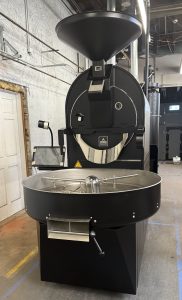
The Callowhill Roasting Company, facility in Philadelphia relies on consistent gas-fired roasting equipment to maintain quality, throughput, and safety for its production operation. When the local utility could not provide enough inlet pressure for the burners, the plant faced repeated limitations on roast schedules and uncertainty around day-to-day capacity. Accardi Companies was engaged to design and supply a dedicated gas booster system so the client could decouple burner performance from upstream utility constraints and protect production, safety, and operating costs.
Project Overview: Existing System Constraints and Risks
Before the upgrade, the facility’s gas supply conditions created several operational constraints:
- Insufficient inlet pressure from the utility during peak periods.
- Unreliable burner performance when multiple pieces of roasting equipment operated together.
- Limited margin to support future expansion of production capacity.
These constraints showed up on the floor as unpredictable roasting windows, increased operator intervention, and concerns about maintaining consistent roast profiles. With gas supply sitting at the edge of equipment requirements, any fluctuation in utility pressure created risk around batch uniformity, combustion stability, and long-term reliability of the roasting equipment.
From a risk perspective, the plant faced three converging issues: exposure to utility-side pressure variation, elevated potential for nuisance shutdowns or lockouts at the burners, and difficulty planning production around an unstable fuel supply. Collectively, these factors increased operating stress on staff and made it harder for the business to commit confidently to production schedules.
Solution: Selected Equipment and System Design Rationale
To address the gas supply limitation, Accardi Companies provided an Aetech MD-303 gas booster package engineered to raise and stabilize the pressure feeding the roasting equipment. Rather than attempting piecemeal adjustments at each burner, the team focused on a central, controlled boost that would give the entire roasting line a predictable supply condition.
Key reasons this configuration was selected included:
- Ability to increase inlet pressure into the specified operating range for the roasting burners.
- Stable discharge pressure to minimize flame instability and nuisance trips when multiple roasters are online.
- Packaged design that fits within the available mechanical space and integrates with existing gas piping.
- Alignment with code and safety requirements for boosted gas systems, including appropriate safeguards and controls.
By sizing the MD-303 around both current and anticipated loads, the design gives the facility a practical path to add or sequence more roasting equipment without re-opening the fundamental question of gas pressure from the utility.
Consultative Execution: Engineering Approach and Coordination
Accardi’s role extended beyond simply shipping a gas booster. The team worked with the client and their contractors to make sure the solution was properly matched to the roasting process and the constraints of the existing building.
Accardi supported the project by:
- Reviewing burner pressure requirements, existing utility delivery conditions, and expected simultaneous loads.
- Coordinating with the installing contractor on equipment placement, piping tie-ins, and service access.
- Providing guidance on controls, safety interlocks, and startup procedures appropriate for a boosted gas system.
During execution, Accardi remained involved through selection, submittals, and commissioning support to help the owner and contractor confirm that the installed system delivered the targeted discharge pressure and operated within safe, code-compliant parameters. This consultative approach reduced guesswork for the project team and helped the client move from a constrained fuel supply to a predictable, engineered solution.
Results & Operational Impact: Post-Installation Performance
Once the MD-303 gas booster was in service, the roasting operation shifted from managing around gas limitations to planning production on a more stable foundation.
Key operational improvements include:
- More reliable gas pressure at the burners, even when multiple roasters are operating simultaneously.
- Reduced risk of nuisance shutdowns or performance issues tied to low inlet pressure.
- Greater confidence in scheduling batches and maintaining consistent roast profiles.
- A clearer path to support future capacity without re-engineering the gas supply from the utility.
For plant staff, these changes translate into fewer last-minute adjustments to production, less concern about whether the gas supply will support a given run, and a more repeatable environment for maintaining quality. From a business standpoint, the improved control over fuel pressure supports predictable throughput and helps protect against unplanned downtime tied to utility-side limitations.
Why This Matters for Similar Facilities and Applications
Many food and beverage operations, small industrial plants, and light manufacturing facilities depend on gas-fired equipment that was originally sized around utility service conditions that have since changed. Where processes such as roasting, baking, or thermal processing are sensitive to flame stability and heat input, insufficient inlet pressure can quietly limit capacity and create day-to-day uncertainty.
Projects like Callowhill Roasting Company, upgrade show how a properly engineered gas booster can separate critical production equipment performance from fluctuating utility delivery. For facilities across New York City, Long Island, and nearby markets that rely on combustion processes, the same approach—tight coordination around burner requirements, gas booster selection, and safety controls—can turn a chronic constraint into a managed, predictable variable.
Request a Free Specification Quote
Commercial and industrial facilities in New York City, Long Island, and the surrounding region that rely on gas-fired processing or heating equipment can request a free specification review from Accardi Companies. The team will evaluate existing loads, current and future equipment requirements, and utility delivery conditions while accounting for DOB and local codes, venting, and space constraints. This engineered, no-obligation consultation is designed to define a practical gas booster or DHW/boiler solution that supports reliable, long-term operation.